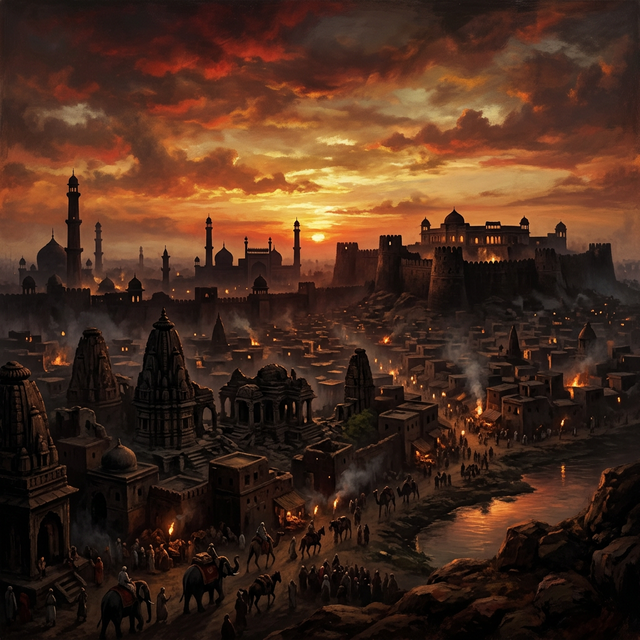
Wide panoramic depiction of medieval Delhi Sultanate circa 1360 CE — silhouettes of ornate mosque minarets and destroyed Hindu temple ruins against a dramatic crimson and golden sunset sky symbolising the era of Firoz Shah Tughlaq's rule

Firoz Shah Tughlaq The Overlooked Tyrant of Medieval India

Portrayed as a benevolent ruler. Remembered for canals and hospitals. But his own court historians documented something else entirely — systematic temple destruction, a slave army of 180,000, forced conversions, and the brutal imposition of jizya on Hindu Brahmins. This is the history they didn't teach you.

Scroll to explore
📊 The Scale of Atrocities

Numbers They Don't Teach

Documented by his own court historians, the Tarikh-i-Firoz Shahi and other primary chronicles — the staggering scale of Firoz Shah Tughlaq's systematic destruction of India's civilization.

â›“ī¸
0
Slaves in Royal Household
Tarikh-i-Firoz Shahi by Shams-i-Siraj Afif — the largest personal slave army in Delhi Sultanate history
đŸ›ī¸
Thousands
Temples Destroyed
Including the famous Jwalamukhi temple raid, Nagarkot, and systematic destruction across Bengal, Orissa, and Sindh
💰
0
Estimated Loot in 2024 Values
Gold, idols, manuscripts, gems extracted from temples & Hindu kingdoms across India
📚
0
Years of Systematic Terror
1351–1388 CE — the longest reigning Tughlaq sultan, with 37 years of documented religious persecution
🧭 Your Journey Through History

What This Encyclopedia Covers

Navigate through each chapter to uncover the layers of truth that have been systematically hidden, whitewashed, or overlooked in mainstream Indian education.

📖
The sanitized textbook narrative vs. documented reality of Firoz Shah Tughlaq
Chapter 1

The Official Narrative

How Indian textbooks have praised Firoz Shah Tughlaq for building canals and hospitals while systematically omitting his documented temple destructions, mass enslavements, and religious persecution.

Uncover the truth →
📅
37 years of documented destruction, year by year
Chapter 2

Timeline of Reign

An interactive, chronological walk through every major event during Firoz Shah Tughlaq's sultanate — from 1351 CE to his death in 1388 CE.

Walk through time →
📜
State policies of religious persecution institutionalized by Firoz Shah
Chapter 3

State Policies of Persecution

The systematic, state-sanctioned policies — jizya on Brahmins for the first time, mandatory conversion incentives, slave raids as royal policy, and the destruction of Hindu and Jain places of worship as official state business.

Read the policies →
â›“ī¸
Systematic religious oppression of Hindu communities
Chapter 4

Religious Persecution

Forced conversions. A slave army of 180,000. Jizya imposed on Brahmins. Mass enslavement of Hindus after military campaigns. The full documented record of Firoz Shah's religious war on India's Hindu majority.

Read the accounts →
đŸ”Ĩ
Manuscript destruction, Jwalamukhi raid, and the erasure of India's indigenous knowledge traditions
Chapter 5

Cultural Destruction

Beyond temples — how Firoz Shah's reign destroyed centuries of Indian manuscript culture, looted Jwalamukhi, Puri Jagannath, Nagarkot, and erased indigenous intellectual traditions across north India.

Understand the loss →
📊
Data visualization of the scale of plunder and destruction
Chapter 6

The Damage Quantified

Numbers, statistics, and data that put the scale of destruction into perspective — wealth looted, temples destroyed, populations enslaved, manuscripts confiscated, economic damage in today's values.

See the numbers →
🔗
How Firoz Shah's legacy connects to India's present struggles
Chapter 7

Legacy & Modern Impact

How Firoz Shah Tughlaq's institutionalization of religious persecution set precedents that outlasted his sultanate — and how its echoes are felt in India even today.

Connect past to present →
📚
Complete bibliography of primary and secondary sources
Chapter 8

Sources & References

Every claim on this site is backed by primary sources — Tarikh-i-Firoz Shahi, Sirat-i-Firoz Shahi, Futuh-us-Salatin, Ferishta. Explore the complete bibliography with verification links.

Verify the sources →
â„šī¸
Our mission, methodology, and commitment to truth
About

About This Project

Why this website exists, our methodology for historical research, our commitment to accuracy, and how you can contribute to this educational initiative.

Learn more →
"Whenever a zimmi (non-Muslim subject) persisted in his infidelity after being warned of the punishment of death, Firoz Shah would send for a quantity of wood, pile it before the offender, set fire to it and throw the zimmi into the flames. Many Hindus were thus burned." — Tarikh-i-Firoz Shahi by Shams-i-Siraj Afif (c. 1398 CE), chief court historian of Firoz Shah Tughlaq
Wikipedia: Tarikh-i-Firoz Shahi
âš ī¸ Why This Matters Today

Firoz Shah Kotla in Delhi — once a symbol of sultanate power — is where Firoz Shah Tughlaq brought and installed the Ashokan Pillar (a pre-Islamic monument) as a trophy. He looted the Hindu Puri Jagannath temple idols, mutilated them, and had them buried under mosque steps so Muslims could tread on them. He personally authored an autobiography boasting about his temple demolitions. These are not contested claims — they are in his own written words. Understanding this history is fundamental to understanding the civilizational wounds India still carries.

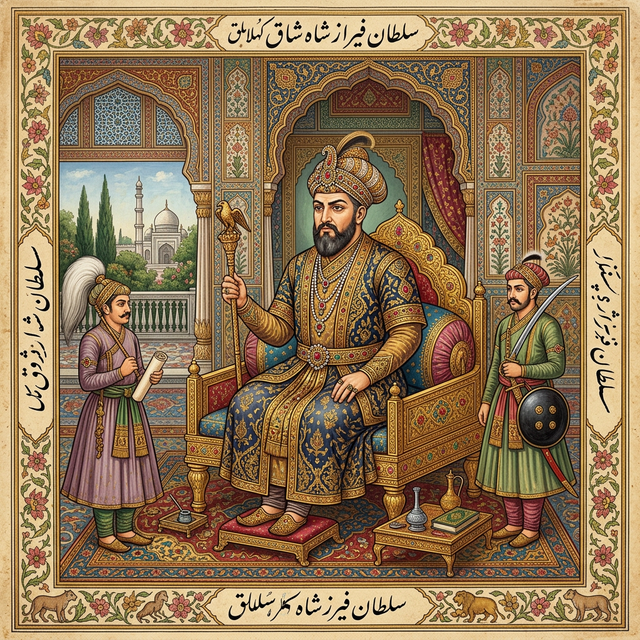
Portrait representation of Firoz Shah Tughlaq — 14th century Delhi Sultan, regal medieval Islamic ruler wearing elaborate royal robes and a turban embroidered with gold, from a historical court painting style

Firoz Shah Tughlaq (1309–1388 CE) — Sultan of Delhi Sultanate (1351–1388 CE)

The Man Behind the Myth

Who Was Firoz Shah Tughlaq?

Firoz Shah Tughlaq (1309–1388 CE) was the third sultan of the Tughlaq dynasty, ruling the Delhi Sultanate for 37 years from 1351 to 1388 CE — the longest reign of any Tughlaq sultan. His reign is remembered in mainstream textbooks for canals, hospitals, and public works.

What the same textbooks leave out: His own court historian, Shams-i-Siraj Afif, wrote in detail about Firoz Shah's burning of Hindus alive, imposition of jizya on Brahmins (unprecedented in the Delhi Sultanate), maintenance of a 180,000-person slave army, systematic temple destructions across Bengal, Orissa, Sindh, and Rajasthan, and his personal role in looting and desecrating India's most sacred Hindu shrines.

This website is dedicated to presenting the complete, source-backed history — not just the sanitized version that has been taught to generations of Indian students.

Read the Full Story →
🔍 Textbook vs. Reality

The Two Faces of Firoz Shah Tughlaq

One version lives in textbooks. The other is documented in primary historical sources written by his own court historians — who celebrated, not criticized, his actions.

📗
What Textbooks Say
  • "A benevolent ruler who built canals, hospitals, and rest houses"
  • "He was known for his welfare measures and public works"
  • "Founded Firoz Shah Kotla and several new cities"
  • "A patron of learning who established madrasas"
  • "He was merciful to subjects and reduced taxes from the Muhammad bin Tughlaq era"
  • "An important administrator who reformed the sultanate's governmental systems"
📕
What History Documents
  • Maintained a slave army of 180,000 — the largest personal slave force in Delhi Sultanate history (Tarikh-i-Firoz Shahi)
  • Imposed jizya on Brahmins — never done before by any Delhi sultan — and burned Hindus alive for professing their faith
  • Personally raided the Jwalamukhi temple in Kangra, looted 1,300 books of Sanskrit knowledge and had them "translated and thus destroyed"
  • Looted Puri Jagannath idols, had them buried under mosque steps so Muslims could tread on them
  • Conducted slave raids after every military campaign — Bengalis, Orissans, and Sindhis enslaved en masse
  • Personally authored Futuhat-i-Firoz Shahi boasting about destroying temples and converting Hindus
đŸ”Ĩ The Crime Against Knowledge

The Jwalamukhi Raid of 1361 CE

1,300 Books of Sanskrit Knowledge — "Translated and Destroyed"

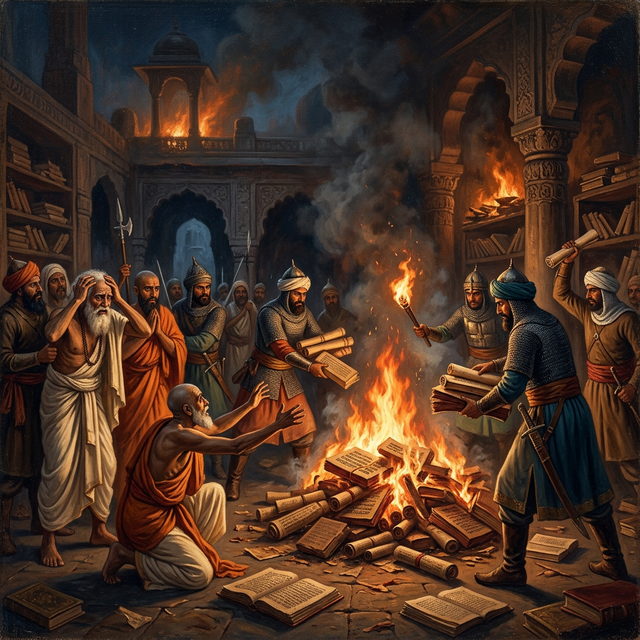
In 1361 CE, Firoz Shah Tughlaq personally led a military expedition to Nagarkot (Kangra) in present-day Himachal Pradesh and raided the Jwalamukhi temple — one of the most sacred Hindu shrines in northern India.

His court historian Shams-i-Siraj Afif records that Firoz Shah confiscated 1,300 books of Sanskrit knowledge from the temple library. These were then taken back to Delhi where scholars were commissioned to "translate" them — a process that, in 14th-century Islamic court practice, meant eliminating the Sanskrit originals and replacing them with Perso-Arabic versions. The originals were destroyed.

This was a deliberate act of intellectual and cultural genocide — not incidental temple raiding, but a targeted assault on India's accumulated scientific, philosophical, and religious knowledge preserved at its sacred centers of learning.

Read Full Account →
Ancient Sanskrit manuscripts and Hindu religious texts being confiscated and destroyed by medieval Islamic soldiers in 14th century India — representing Firoz Shah Tughlaq's raid on the Jwalamukhi temple library in 1361 CE where 1300 books of Sanskrit knowledge were taken and effectively destroyed through coercive translation
đŸ•¯ī¸ Education is the First Step

History Forgotten is History Repeated

This website exists because every Indian has the right to know their true history. Every claim is backed by primary historical sources. Every fact is verifiable. Begin your journey through the chapters that textbooks left out.

🌐 Bharat Files Initiative

Explore Sister Projects

Firoz Shah Tughlaq is one chapter. The full history of India's subjugation is documented across these comprehensive educational resources — all part of the Bharat Files Initiative.

Tughlaq Dynasty

Ghiyasuddin Tughlaq

Founder of the Tughlaq dynasty whose reign set the precedent for continued temple destruction and expansion of sultanate control.

ghiyasuddintuqhlaq.com →
Mughal Empire

Aurangzeb Alamgir

The Mughal emperor who reimposed jizya, destroyed thousands of temples and waged systematic religious war against India's Hindu majority.

aurangezebalamgir.com →
Ghurid Dynasty

Muhammad Ghori

The conqueror who established the Delhi Sultanate through which Firoz Shah's policies of religious persecution were inherited and amplified.

muhammadnaghori.com →