Chapter 7
Legacy & Modern Impact
How Firoz Shah Tughlaq's institutionalized persecution set precedents that echoed through subsequent rulers — and how those echoes continue to shape modern India.
How Firoz Shah Tughlaq's institutionalized persecution set precedents that echoed through subsequent rulers — and how those echoes continue to shape modern India.
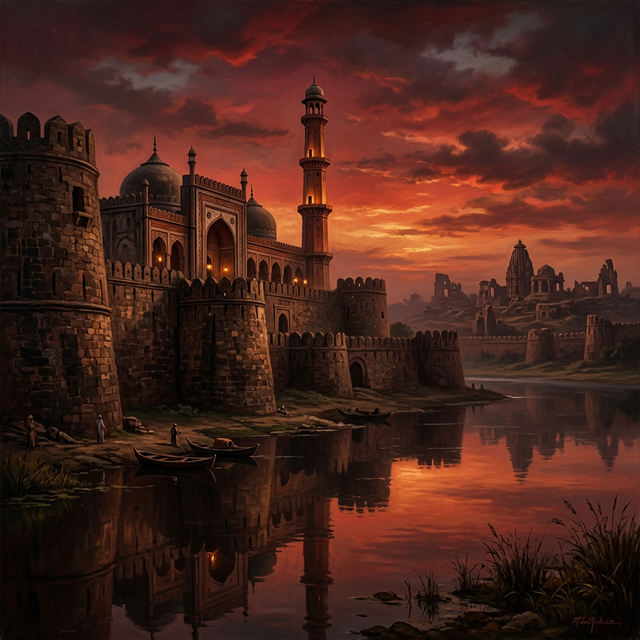
Firoz Shah Kotla (Delhi) — Built using enslaved Hindu labor. Home to a looted Ashokan Pillar brought here by Firoz Shah as a trophy of his conquests. Still stands in Delhi today.
One of the most iconic acts of Firoz Shah Tughlaq's reign is his transportation of the Ashokan Pillar from Topra (Haryana) to Delhi — a feat of medieval engineering that is often celebrated in Indian textbooks as evidence of his interest in ancient Indian heritage.
The reality is more complex. The Ashokan Pillar is a sacred monument from the Mauryan era — Emperor Ashoka's edicts inscribed in ancient Brahmi script. It is a monument of pre-Islamic India, of Buddhist and Hindu civilization. Firoz Shah did not bring it to Delhi out of scholarly reverence — he brought it as a trophy of conquest, to display in his own fortress as evidence of his dominion over Indian civilization.
The pillar was brought to Delhi in 1356 CE, wrapped in raw silk and animal skins, transported on a specially constructed vessel. It was installed at Firoz Shah Kotla — a fortress built with 180,000 slave laborers — not in a museum or center of learning, but as a monument to the sultan's triumph.
Firoz Shah Tughlaq's most consequential legacy was not his canals or his cities — it was the institutional precedents he established for how a Delhi Sultanate ruler could treat India's Hindu majority:
By imposing jizya on Brahmins — previously exempt — Firoz Shah established the principle that no Hindu class, however sacred or socially significant, was beyond the reach of discriminatory taxation. This precedent would be invoked by later rulers, most notably by Aurangzeb, who reimposed and dramatically expanded jizya three centuries later.
The systematic use of military campaigns to generate slave labor — building a household economy on the backs of captured Hindus — established a model that subsequent Sultanate-era rulers would emulate. The normalization of mass enslavement as a byproduct of military campaigns had devastating long-term consequences for India's indigenous population.
The use of financial incentives for conversion, combined with discrimination against non-converts, as a deliberate demographic engineering policy was formalized under Firoz Shah. This model — rewarding conversion, penalizing non-conversion — created religious demographic shifts in Bengal, Sindh, and Punjab whose consequences are still visible in modern South Asia.
The burning alive of Hindus for publicly practising their faith — a practice Firoz Shah's own historian records and praises — established a precedent of state-sanctioned religious murder that subsequent rulers could cite as legitimate Islamic governance practice.
The 1947 Partition of India — and the genocidal violence that accompanied it — did not emerge from nowhere. It emerged from centuries of demographic and civilizational change that had created fundamentally different communities in different parts of the subcontinent.
The mass conversions — partly forced, partly incentivized — during the Tughlaq era (1320–1412 CE, including Firoz Shah's 37 years) were a significant driver of the Muslim-majority populations that formed in Bengal and Punjab. These demographics, created over centuries of religious coercion under sultans like Firoz Shah, ultimately became the basis for Pakistan and Bangladesh.
When Indians ask "why was Partition so violent?" — why did communities that had lived together for centuries suddenly turn on each other — the answer lies partly in the centuries of forced separation, state-sponsored religious discrimination, and civilizational trauma that sultans like Firoz Shah Tughlaq institutionalized. Understanding this chain of causation is not about assigning blame — it is about understanding history honestly.
The Firoz Shah Kotla complex in Delhi is a UNESCO-listed monument. Indians can visit it today. The Ashokan pillar he looted from Topra stands there still. But there are no plaques explaining that it was built by 180,000 slaves. No memorial for the Hindus burned alive in his reign. No acknowledgment of the Puri Jagannath idols buried under his mosque steps.
History presented selectively — emphasizing the architecture, erasing the human cost — is not education. It is propaganda.
Some of what Firoz Shah Tughlaq destroyed cannot be recovered:
Firoz Shah Tughlaq did not operate in a vacuum. His reign was one chapter in a longer history of religious persecution during India's Sultanate period — a period documented comprehensively by the Bharat Files Initiative.
The full context requires understanding:
Understanding this chain of persecution — from the Arab invasion of Sindh in 712 CE to Aurangzeb's Mughal empire — is the mission of the Bharat Files Initiative. Explore our sister projects to see the full picture:
View All Sister Projects →