Chapter 3
State Policies of Persecution
The systematic, state-sanctioned policies that institutionalized religious discrimination, enslavement, and cultural destruction during Firoz Shah Tughlaq's 37-year reign.
The systematic, state-sanctioned policies that institutionalized religious discrimination, enslavement, and cultural destruction during Firoz Shah Tughlaq's 37-year reign.
What distinguished Firoz Shah Tughlaq from many of his predecessors was not merely the existence of religious persecution — that existed throughout the Delhi Sultanate period — but the systematic, institutionalized, policy-driven nature of his persecution of Hindus. He built structures, created incentives, and authored texts that were designed to permanently alter India's religious demography and erase its indigenous civilization.
The jizya was a poll tax levied on non-Muslims (dhimmis) in Islamic states in lieu of mandatory military service. In the Delhi Sultanate, it had been a controversial but accepted part of Muslim rule over an overwhelmingly Hindu population.
However, all previous Delhi Sultans had exempted Brahmins from jizya. This was partly practical (taxing the brahminical class risked massive social unrest) and partly because even many Islamic legal scholars recognized that learned religious men who devoted themselves to spiritual practice had a special status.
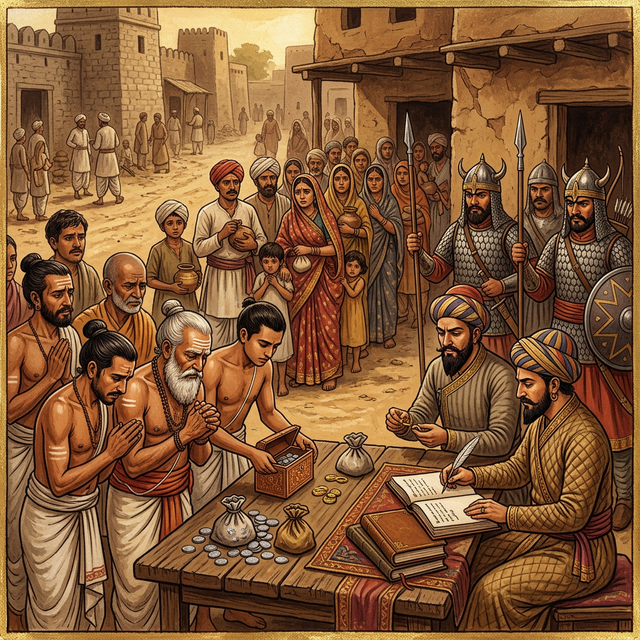
Firoz Shah Tughlaq ended this exemption. He imposed jizya on Brahmins — a step unprecedented in Delhi Sultanate history. When the Hindu community of Delhi organized a large protest, calling it unjust and contrary to established practice, Firoz Shah's response was documented by his own historian Shams-i-Siraj Afif:
The protest leaders — Brahmins who led the community's objection to an unprecedented and unjust tax — were publicly burned alive on the sultan's orders. This was not a wartime atrocity. This was a peacetime policy of state-sponsored religious terror.
Firoz Shah Tughlaq maintained what his own court historian describes as a personal slave household of 180,000 individuals. This was not a small domestic staff — it was a vast workforce of enslaved human beings, predominantly Hindus captured during military campaigns, who served in the royal palace, in construction, in the military, and in workshops producing goods for the sultanate.
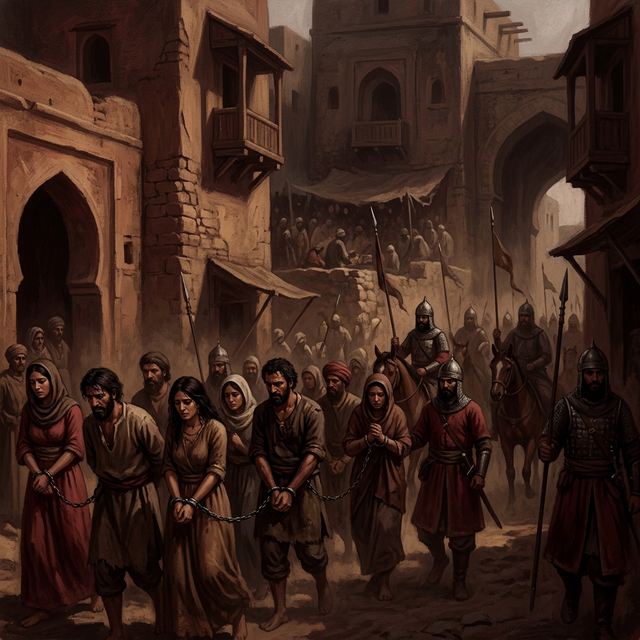
Shams-i-Siraj Afif describes this in Tarikh-i-Firoz Shahi:
This slave workforce was built through a deliberate policy of conducting slave raids in conjunction with every military campaign. After each victory — in Bengal, Orissa, Sindh, or Rajasthan — Firoz Shah's forces would systematically capture portions of the local Hindu population and bring them back to Delhi. The largest slave army in Delhi Sultanate history was built human-by-human through what can only be described as industrialized enslavement.
180,000 enslaved human beings — the largest slave army in Delhi Sultanate history — is mentioned in precisely zero mainstream Indian school textbooks. The same textbooks mention Firoz Shah's canals in detail.
Unlike some sultans who destroyed temples as a byproduct of military campaigns, Firoz Shah Tughlaq made temple destruction an explicit peacetime domestic policy. He applied it to his own capital, Delhi, ordering the demolition of newly built Hindu temples within the city itself.
In his own words, from Futuhat-i-Firoz Shahi:
Major documented temple destructions under Firoz Shah Tughlaq include:
Firoz Shah created a systematic incentive structure designed to encourage mass conversion of Hindus to Islam. Converts received:
Simultaneously, those who refused to convert faced increasing jizya burdens, and those who practised their Hindu faith publicly — including public worship, festivals, or congregational prayer — faced the risk of arrest and execution.
This was a deliberate demographic policy. By making Islam economically attractive and Hindu practice economically punitive — and by making open Hindu religious practice physically dangerous — Firoz Shah sought to systematically alter the religious composition of the Delhi Sultanate's population.
The raid on the Jwalamukhi temple in 1361 CE was not just cultural vandalism — it was a targeted policy of intellectual warfare. By seizing and "translating" the Sanskrit texts from the temple library, Firoz Shah was attempting to appropriate and reformulate India's indigenous knowledge systems within an Islamic scholarly framework.
The process of "translation" in medieval Islamic courts typically involved:
The 1,300 Sanskrit texts seized from Jwalamukhi covered astronomy, mathematics, medicine, philosophy, and religious texts — a substantial repository of accumulated Hindu learning. Their destruction through coercive translation represents a loss to Indian civilization that cannot be quantified.