Chapter 4
Religious Persecution
Forced conversions. Hindus burned alive. Mass enslavement. Jizya on Brahmins. The complete documented record of Firoz Shah Tughlaq's war on India's Hindu majority.
Forced conversions. Hindus burned alive. Mass enslavement. Jizya on Brahmins. The complete documented record of Firoz Shah Tughlaq's war on India's Hindu majority.
The religious persecution under Firoz Shah Tughlaq was not incidental to his reign — it was central to his self-identity as ruler. His own written testament Futuhat-i-Firoz Shahi frames his entire sultanate as a religious mission: converting Hindus to Islam, destroying their temples, and establishing Islamic supremacy over India's Hindu majority. What follows is a complete account, drawn from primary sources.
Perhaps the most shocking documented atrocity of Firoz Shah Tughlaq's reign is the systematic burning alive of Hindus who refused to convert to Islam or who attempted to practise their faith publicly. This is not an allegation — it is recorded in laudatory, approving terms by his own court historian.
The phrase "persisted in his infidelity" refers to Hindus who refused to convert to Islam when ordered or pressured to do so. In other words, the "crime" punishable by burning alive was the refusal to abandon one's religion.
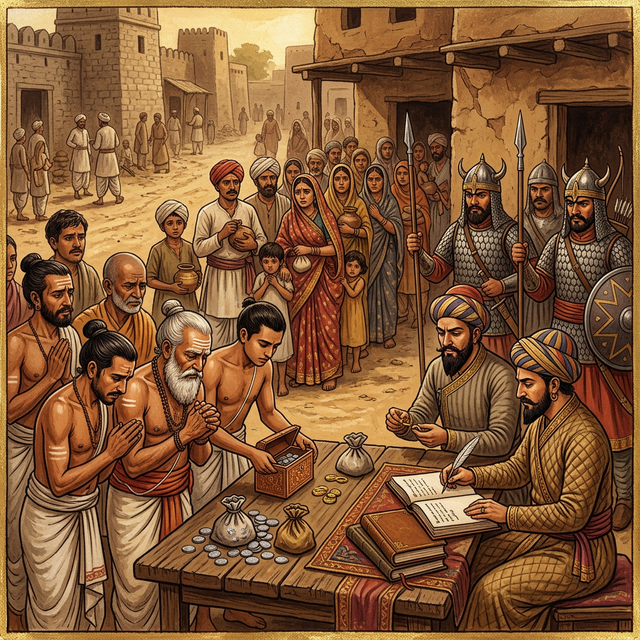
Afif documents a specific incident in which Hindu protest leaders who objected to the imposition of jizya on Brahmins were publicly burned as a lesson to the population:
The imposition of jizya on Brahmins was a deliberate escalation of religious discrimination that no previous Delhi Sultan had attempted. Previous rulers had recognized that overtaxing the brahminical class — who served as teachers, priests, record-keepers, and community leaders — would create unsustainable social disruption.
Firoz Shah's decision to impose jizya on Brahmins had multiple objectives:
The public burning of protest leaders who objected to this policy served as a brutal signal: the protection previously afforded to Brahmins was over.
The 180,000 people in Firoz Shah's slave household were not there by choice or contract. They were captured human beings — predominantly Hindus seized during military campaigns and reduced to slavery as a deliberate policy of warfare and state revenue generation.
The pattern was consistent: every time Firoz Shah conducted a military campaign — against Bengal, Orissa, Sindh, or Rajasthan — his forces would systematically capture members of the local Hindu population. These captives were then:
Tarikh-i-Firoz Shahi records that Firoz Shah established a dedicated administrative department — the diwan-i-bandagan (Department of Slaves) — to manage his enormous slave workforce. This bureaucratic institutionalization of human slavery is a distinctive feature of his reign.
While Firoz Shah's approach to conversion combined incentives (economic benefits for converts) with coercion (burning, jizya burden, legal discrimination for non-converts), there are also documented instances of direct forced conversion — particularly in the context of military campaigns.
After military victories, local Hindu leaders and prominent figures were often given a stark choice: convert to Islam and retain their position, or lose their social status, property, and — in cases where they resisted — their lives.
This is Firoz Shah in his own voice, articulating his own political theology: conversion of Hindus is a religious obligation and a moral duty of his sultanate. This framing helped justify every form of coercion his regime employed.
The villages and communities that converted to Islam in large numbers during the Tughlaq era — particularly in Bengal, Punjab, and Sindh — form the demographic basis of communities that, centuries later, would partition from India in 1947. Understanding the forced and incentivized nature of these medieval conversions is essential context for understanding modern South Asia's religious geography.
Beyond demolition, Firoz Shah engaged in deliberate desecration of Hindu sacred sites — acts designed not merely to destroy but to humiliate and degrade the religious sensibilities of India's Hindu majority.
The most documented of these acts is the treatment of idols seized from the Puri Jagannath temple during his Orissa campaign:
Puri Jagannath is one of the four dhams — the holiest sites in Hinduism, visited by tens of millions of Hindus annually even today. The deliberate burial of its idols under mosque steps was a calculated act of religious supremacism — a statement that the God of India's Hindus would be literally beneath the feet of its Muslim rulers.
This is the act that most Indian textbooks do not mention when describing Firoz Shah Tughlaq's reign.