Chapter 5
Cultural Destruction
How Firoz Shah Tughlaq systematically targeted India's temples, manuscripts, artistic traditions, and sacred centers of learning — destroying centuries of accumulated civilization.
How Firoz Shah Tughlaq systematically targeted India's temples, manuscripts, artistic traditions, and sacred centers of learning — destroying centuries of accumulated civilization.
The cultural destruction wrought by Firoz Shah Tughlaq went far beyond the physical demolition of temples. It was a comprehensive assault on the intellectual, artistic, and civilizational fabric of medieval Hindu India — targeting sacred texts, musical traditions, temple arts, and the very institutions that had sustained India's indigenous knowledge systems for millennia.
In 1361 CE, Firoz Shah personally led a military expedition to Nagarkot (Kangra) in present-day Himachal Pradesh. The primary target was the Jwalamukhi temple — the sacred flame temple dedicated to the goddess of light, one of the most revered Shakti peethas in northern India.
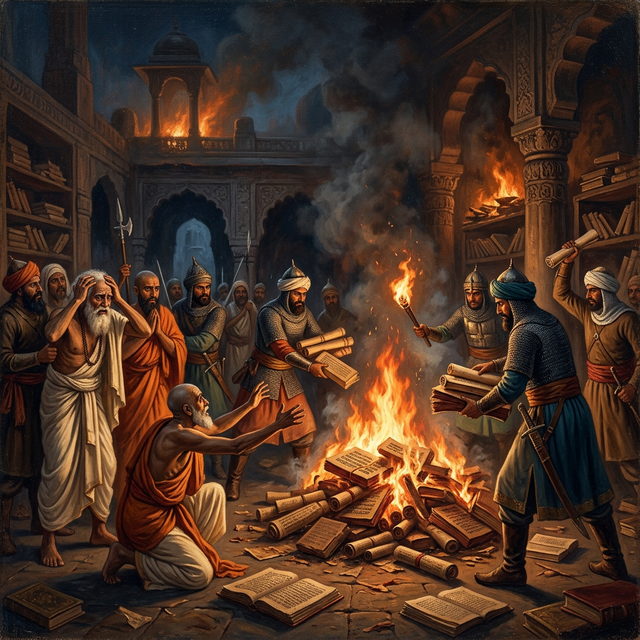
Beyond the physical destruction, Firoz Shah's forces seized the temple library: 1,300 volumes of Sanskrit texts covering astronomy, mathematics, medicine, music theory, philosophy, and Hindu scripture.
These texts were taken to Delhi. Firoz Shah commissioned scholars to "translate" them into Persian and Arabic. His court historian Shams-i-Siraj Afif records this:
The medieval Islamic court practice of "translation" was not a preservationist act — it was an act of cultural transformation. The original Sanskrit context, the ritual framework, the divine imagery — everything that gave these texts their meaning within Hindu civilization — was stripped away. The Sanskrit originals were not preserved; they were replaced by decontextualized Perso-Arabic versions.
1,300 volumes of India's accumulated knowledge — centuries of scientific observation, philosophical reasoning, musical theory, and astronomical calculation — were effectively lost to India through this act of state-sponsored intellectual theft.
Hindu temples in medieval India were not merely places of worship — they were repositories of craft, artistic tradition, musical practice, dance, and community knowledge. The temple complex served as:
When Firoz Shah Tughlaq demolished temples — in Delhi, Nagarkot, Sindh, Bengal, and Orissa — he was not merely destroying a building. He was destroying the entire ecosystem of cultural production and knowledge transmission that the temple supported.
The craftsmen who carved the temple sculptures, the priests who maintained the rituals, the musicians who performed for the deity, the scholars who taught from the temple library — all were displaced or enslaved when their temple was destroyed.
The architectural traditions of temple carving that flourished in medieval Hindu India — particularly the schools of stone carving in Rajasthan, Orissa, and Bengal — suffered a generational break during the Tughlaq era. Master craftsmen fled or were enslaved. Apprenticeship chains that had transmitted craft skills for generations were severed. Some of these artistic traditions have never fully been recovered.
The raid on Puri Jagannath temple during Firoz Shah's Orissa campaign (c. 1360 CE) was one of the most significant acts of cultural desecration in medieval Indian history. Jagannath — "Lord of the Universe" — is one of the four dhams (sacred destinations) of Hinduism and is central to the religious life of hundreds of millions of Indians.
Firoz Shah's forces, upon reaching Puri, seized the temple's main idols. According to Tarikh-i-Firoz Shahi, these idols — including the murti of Jagannath — were taken to Delhi and, by the sultan's order, buried under the steps of the Jami Masjid (Friday Mosque) so that Muslims could walk over them when entering for prayer.
This act had profound cultural and psychological consequences for India's Hindu majority. It was not merely destruction — it was deliberate, calculated subordination: the sacred made profane, the divine made dirt beneath the feet of the conqueror's religion.
The emotional and spiritual injury this caused to the Hindu community of medieval India cannot be measured in economic terms. But its effects on Hindu-Muslim relations, and on the psychology of a civilization that had been told its most sacred objects were fit only to be trodden underfoot, lasted for centuries.
Firoz Shah's orthodox Islamic governance extended to the regulation and suppression of Hindu musical and performing traditions. The devadasi tradition — female temple performers who maintained classical dance and music in service of the deity — was explicitly targeted as morally objectionable by the orthodox Islamic establishment that Firoz Shah championed.
While complete prohibition was not possible across a sultanate as large as Firoz Shah's, the destruction of temples — which were the institutional patrons and venues for these performing traditions — effectively eliminated their contexts of practice. Classical dance forms preserved in Orissa (what would become Odissi), Bengal, and north India lost their temple patronage and institutional homes during this era.
The fact that classical Indian dance forms survived at all is a testament to the resilience of Indian culture — not to the mercy of its medieval Islamic rulers.